SEO
SEO
 Web Design & Development
 Google Ads
 Social Media Ads
 App Design & Development
 Lawyer
 Tradies
 E-commerce


 June 16, 2026
If you want to promote your business in social media, you might wonder: what platforms to use? What to post? Or whether any of it is actually worth your time?
Most Australian business owners feel the same way when they’re starting out. This guide will walk you through everything you need to know: what social media marketing is, how each platform works, and how to build a strategy that drives real business results.
If you’d rather skip the learning curve, our social media advertising team can take it off your hands!
What Is Social Media Marketing?
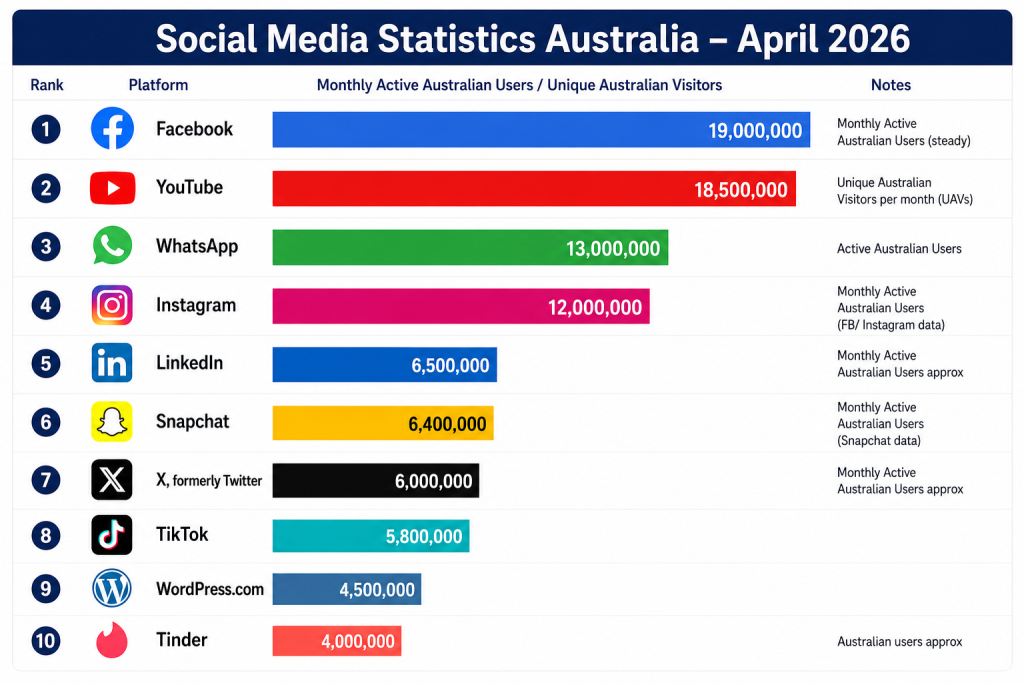
https://www.socialmedianews.com.au
Social media marketing is the use of platforms like Facebook, Instagram, TikTok, LinkedIn, and YouTube to build brand awareness, connect with your audience, and drive measurable business outcomes.
It covers two distinct approaches: organic content (the posts, stories, and reels you publish for free on your business profile) and paid advertising (sponsored campaigns that put your content in front of people beyond your existing followers).
In Australia, social media adoption is among the highest in the world. With over 21 million active social media users locally, it’s one of the most direct ways to reach your customers — whether you’re a tradie, retailer, professional service, or e-commerce brand.
Social Media Marketing vs. Other Digital Marketing Channels
One thing to keep in mind, social media doesn’t replace other digital channels, instead it works alongside them. Here’s a quick comparison to help you understand where it fits in the broader marketing mix:
| Channel | Best For | Speed of Results | Typical Cost |
| Social Media | Brand awareness, community building, remarketing | Medium | Low–High (depends on paid spend) |
| Search Engine Optimisation | Long-term organic traffic from Google | Slow (3–6+ months) | Low ongoing (higher upfront) |
| Google Ads | Capturing high-intent buyers searching right now | Fast (days) | Medium–High |
| Email Marketing | Nurturing leads and existing customers | Fast | Low |
Key insight: These channels complement each other rather than compete. Here is a common scenario: a customer sees your Instagram ad, searches your business on Google, then converts after an email follow-up. Each channel played a role.
The Main Social Media Platforms: Which One Is Right for You?

You don’t need to be on every platform. Start with one or two where your target customers are most active, then expand from there.
Facebook remains one of Australia’s largest social media platforms and continues to be particularly effective for local businesses, community engagement, and audiences aged 30 and above.
YouTube
Australia’s most-used video platform. Works well for longer tutorials, product demonstrations, and brand storytelling. Content here has a long shelf life, a good video can drive traffic for years.
Highly visual and strong for retail, food, fashion, lifestyle, and home improvement brands. Reels (short-form video) are currently getting strong organic reach. Skews slightly younger than Facebook but with significant overlap.
TikTok
One of Australia’s fastest-growing and most influential social media platforms, particularly among younger audiences. Short-form video is the format. Excellent for brand discovery and top-of-funnel awareness, even for businesses that don’t think of themselves as “content creators.”
The go-to platform for B2B marketing, professional services, and recruitment. If your customers are other businesses or decision-makers, LinkedIn is worth prioritising. It has lower volume than other platforms but much higher intent in professional contexts.
Organic vs. Paid Social Media Marketing

Understanding the difference between organic and paid social is critical for making smart budget decisions.
- Organic social media is the content you publish on your business page or profile for free. It can be posts, stories, reels, and videos. It builds your brand over time, nurtures existing followers, and establishes trust.The trade-off: organic reach on most platforms (particularly Facebook) has declined sharply over the past decade. Even a page with thousands of followers might only reach a small percentage of them with any given post.
- Paid social media advertising solves the reach problem. By running targeted ad campaigns, you can put your content in front of precisely the right people,filtered by factors such as location, age range, interests, behaviours, and other platform-specific audience signals.
Social media ads are how most businesses move from building an audience to actually generating leads and sales.
The most effective approach is combining both organic content for community building and trust, and paid campaigns for reach and conversions.
How to Build a Social Media Marketing Strategy

A social media presence without a strategy is just noise. Here’s how to build one that actually connects to your business goals.
1. Set clear goals
What do you want social media to do for your business? Common goals include brand awareness, website traffic, lead generation, and direct sales. Vague goals lead to vague results, so be specific.
2. Define your target audience
Who are your ideal customers? How old are they, where do they live, what problems are they trying to solve? The more clearly you can answer this, the better your content and targeting will perform.
3. Choose the right platforms
Refer to the platform breakdown above. Pick one or two based on where your audience actually spends time, not where you think you “should” be.
4. Plan your content
Many marketers use an 80/20 framework as a starting point, where most content provides value and a smaller portion focuses on direct promotion.
It means: 80% value-driven content (education, entertainment, behind-the-scenes, tips) and 20% promotional. Because audiences will disengage quickly when every post is a sales pitch.
5. Build a content calendar
Consistency matters more than frequency. Posting three times a week every week beats posting ten times one week and going silent for a month. A simple calendar, even a spreadsheet, keeps you on track.
6. Engage with your audience
Social media is a two-way channel. Reply to comments and direct messages. Ask questions. Acknowledge user-generated content. Businesses that treat social as a broadcast-only channel miss most of the value.
7. Measure and optimise
Review your performance data regularly and adjust. What’s resonating? What’s being ignored? Drop what isn’t working and double down on what is.
Key Metrics to Track in Social Media Marketing

Metrics fall into four categories, and each has a different impact for business.
Awareness metrics
Reach (how many unique accounts saw your content) and social media impressions (total number of times your content was displayed, including repeat views) are useful for understanding top-of-funnel visibility.
Engagement metrics
Likes, comments, shares, saves, and engagement rate (engagement ÷ reach). These indicate how well your content is resonating with the people who see it.
Traffic metrics
Link clicks and website sessions from social. These measure whether social media is actually driving people to your site.
Conversion metrics
Leads generated, purchases made, cost per lead, and ROAS (return on ad spend). These tie directly to business outcomes and are the metrics that actually matter when evaluating paid campaigns.
One important note: don’t chase vanity metrics like follower count! A page with 500 highly engaged, in-market followers will consistently outperform one with 10,000 passive ones.
Common Social Media Marketing Mistakes to Avoid
Most social media problems fall into predictable patterns:
- Trying to be on every platform at once. It is when you spread effort too thin and do nothing well
- Posting inconsistently by going quiet for weeks damages algorithmic reach and audience trust
- Only posting promotional content. Audiences disengage fast when there’s no value beyond the sell
- Ignoring comments and messages. This signals to both the algorithm and your audience that you’re not paying attention
- Not tracking any data. If you’re not measuring, you can’t improve
- Underestimating the time and skill required. This is the most common reason Australian SMEs eventually outsource to a specialist social media advertising agency
When Should You Consider Paid Social Media Advertising?
Organic social is a great foundation, but there are clear signals that it’s time to invest in paid campaigns:
- Your organic reach has plateaued and growth has stalled
- You need faster results than organic can deliver
- You have a specific campaign to run like a product launch, seasonal promotion, or event
- You want to reach new audiences beyond your existing followers
Paid social media advertising allows you to target precisely — by postcode, age, interest, purchase behaviour, and more. It’s how businesses go from having a social presence to actually using it as a revenue channel.
If you’re ready to run paid ads but aren’t sure where to begin, our social media advertising team can help you set up, manage, and optimise campaigns from day one.
Frequently Asked Questions About Social Media Marketing
How much does social media marketing cost in Australia?
Organic social media is free, aside from the time you invest. Paid campaigns vary widely, many Australian SMEs start with $500–$2,000 per month in ad spend, scaling up as results improve. Agency management fees are separate and depend on the scope of work.
How long does it take to see results from social media marketing?
Paid campaigns can generate results within days. Organic growth is slower — expect to see meaningful traction after three to six months of consistent posting and engagement. Building a genuine audience takes time, but it compounds.
What is the best social media platform for small businesses?
It depends entirely on your audience. Service businesses targeting local consumers usually do well on Facebook and Instagram. B2B businesses should prioritise LinkedIn. If your audience skews younger or you’re selling products with strong visual appeal, TikTok and Instagram are worth exploring first.
What is the difference between social media marketing and social media advertising?
Social media marketing is the broader practice, it includes both organic content and paid campaigns.
Meanwhile, social media advertising refers specifically to paid campaigns where you pay to reach a defined audience. Both are part of a complete social media strategy, but they serve different purposes and operate on different timelines.
Do I need a social media manager or can I do it myself?
You can absolutely manage social media yourself, especially when starting out. The challenge is consistency, it requires regular time, creative output, and attention to data.
Many business owners manage it well initially but find it harder to maintain as the business grows. At that point, working with a specialist often delivers better results with less of your own time.
Get a Social Media Strategy That Actually Delivers
Social media marketing isn’t about posting for the sake of it, it’s about building genuine connections, showing up consistently, and using the right channels to reach the right people.
Done well, it’s one of the most powerful tools available to Australian businesses. Done poorly, it’s a lot of effort for little return. The difference is usually strategy, consistency, and knowing which metrics actually matter.
If you want help building a social media strategy that delivers real ROI for your business, get in touch with our team at Ostenpowers!