SEO
SEO
 Web Design & Development
 Google Ads
 Social Media Ads
 App Design & Development
 Lawyer
 Tradies
 E-commerce



 June 23, 2026
The way people search for products and services has fundamentally shifted. Gone are the days when users relied exclusively on clicking the “ten blue links” on a search engine results page.
Today, search engines instantly synthesize answers using artificial intelligence right at the top of the screen.
By mid-2025, AI Overviews appeared in up to 39% of Australian searches, which is well above
the global average, according to Netstripes. At the same time, businesses embracing AI-driven SEO strategies are seeing tangible benefits,that AI-powered SEO campaigns can increase organic traffic by as much as 45%.
It means, for Australian small-to-medium enterprises (SMEs), adapting to this environment is part of maintaining the existence of business in this era. AI SEO is the practice of making sure your business stays visible in this new landscape.
If you are looking to get ahead of the curve, partnering with an experienced SEO services team is the best way to secure your digital footprint.
What Is AI SEO?

AI SEO is the practice of optimising your digital content so it gets found, cited, or summarised within AI-powered search experiences. This encompasses major engines and tools including Google AI Overviews, ChatGPT Search, Perplexity, and Bing Copilot.
Crucially, AI SEO sits alongside traditional search engine optimisation rather than replacing it. Achieving high rankings in standard organic search results remains vital. Furthermore, Google’s generative systems generally pull source material from web pages that already perform strongly via conventional methods.
Within AI SEO, two key sub-disciplines have emerged:
- GEO (Generative Engine Optimisation): Optimising content specifically for generative AI models and conversational search engines.
- AEO (Answer Engine Optimisation): Refining text so it directly answers specific user queries, making it highly extractable for AI summaries and featured snippets.
How Has AI Changed the Way Search Engines Work?

Search engines have shifted from matching exact strings to interpreting intent and context.
The mechanics behind online discovery have transformed dramatically over the past few years, altering how search engines process information and serve users.
From Ranking Keywords to Answering Questions
Modern search engines do not merely match isolated keywords. Instead, they interpret context, user intent, and relationships between real-world entities.
Ranking successfully is no longer about repeating a phrase a set number of times on a page. According to industry insights from 2026, it is about whether your content resolves a user’s problem better, faster, and more comprehensively than alternative sources.
This evolution makes semantic SEO and clear topic authority more important than ever.
Google AI Mode, AI Overviews, and What They Mean for Clicks
Google AI Overviews represent a significant departure from traditional blue links, offering fully generative responses powered by advanced models like Gemini.
Data indicates that AI Overviews correlate with a notable 34.5% drop in click-through rates (CTR) for top organic positions. Some websites have even experienced overall organic traffic contractions ranging from 20% to 60%.
For local SMEs, the reality of “zero-click” searches is here. The solution is to adapt your strategy to capture AI citations and direct mentions, rather than relying strictly on standard ranking positions.
The Rise of Multi-Platform Search
Users no longer rely solely on Google. Instead, they frequently turn to conversational AI platforms like ChatGPT, Perplexity, and Bing Copilot to gather information and make purchasing decisions.
In fact, ChatGPT accounts for 87.4% of all AI referral traffic across monitored websites. Consequently, expanding your visibility across these large language models (LLMs) is a core pillar of modern search engine marketing.
How Businesses Are Using AI to Improve SEO
AI tools help marketing teams uncover insights and diagnose technical issues at scale.
Beyond adapting to how users discover information, businesses are leveraging AI tools internally to make their search optimisation workflows faster and far more efficient.
Keyword Research and Topic Discovery
AI tools can process massive keyword datasets in seconds, identifying underlying intent patterns that manual analysis might easily overlook. They help group phrases by underlying topic rather than search volume alone, perfectly aligning with how modern algorithms interpret content.
Note: Always validate AI-generated keyword ideas using established platforms like Semrush or Ahrefs. AI can sometimes invent search demand or misjudge the intent behind a query.
Content Ideation and Optimisation
Artificial intelligence helps identify content gaps by scanning what competitors cover and highlighting where your pages fall short.
These platforms also provide real-time recommendations regarding semantic keyword coverage, logical heading structures, and overall readability.
Important Caveat: Google welcomes AI-assisted content, provided it remains helpful, original, and demonstrates genuine E-E-A-T (Experience, Expertise, Authoritativeness, Trustworthiness). Generic, low-effort content stuffed with keywords will consistently underperform.
Technical SEO Diagnostics
AI-powered systems can automate site audits, flag crawl complications, monitor Core Web Vitals, and prioritise necessary technical fixes based on potential impact.
This level of automation is highly beneficial for growing websites where manual page-by-page inspection is impractical. It also supports teams in tracking impressions across campaigns and organic performance metrics.
Competitor Monitoring
AI platforms track competitor keyword movements, backlink acquisitions, and content updates in near-real-time.
This gives agile SMEs rapid visibility into shifting market dynamics. When paired with AI-driven bidding, businesses can automate and refine both their organic and paid search strategies simultaneously.
How to Optimise Your Content for AI Search Results
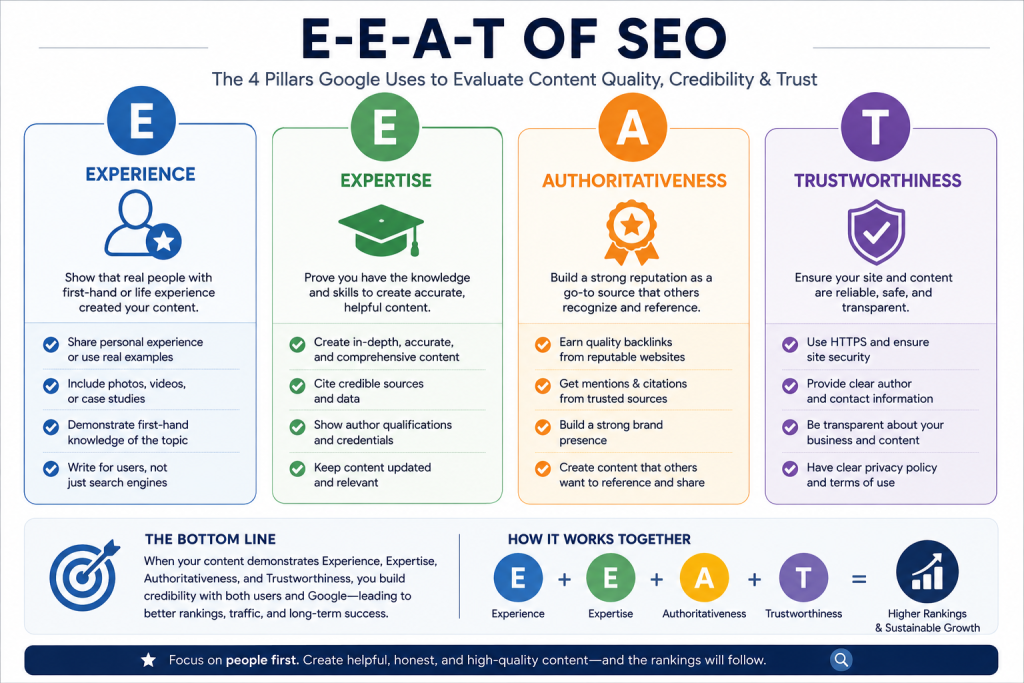
Solidifying your authority and structure helps machines easily read and cite your business.
To maintain digital visibility in an AI-driven landscape, you need to proactively format and structure your information so machines can easily interpret it.
Build Strong E-E-A-T Signals
E-E-A-T stands for Experience, Expertise, Authoritativeness, and Trustworthiness. AI evaluation systems are explicitly programmed to prioritise content that clearly demonstrates these traits.
- Practical Steps: Include detailed author bios featuring real credentials, cite credible industry sources, keep publication dates current, and earn high-quality mentions from reputable websites.
Write for Questions, Not Just Keywords
Anchor your content around the specific, conversational questions your target audience asks. This is exactly the type of data AI systems are built to extract and summarise.
Use question-based H2 and H3 headings throughout your articles. Provide a concise, direct answer of 40 to 60 words immediately beneath the heading before expanding on the topic in greater detail.
Use Structured Data and Clear Formatting
Clean HTML markup, accurate schema, and clear formatting make it much easier for machine intelligence to understand and correctly cite your web pages.
Break up dense blocks of text using bullet points, numbered steps, and direct, definition-style answers. Highly formatted, scannable layouts are incredibly attractive to AI extraction engines.
Get Featured Snippets
Google’s AI Overviews frequently draw source material directly from content that already holds a featured snippet position.
Therefore, targeting snippets serves as one of the most reliable pathways to achieving AI citations. Focus on creating clear definitions, step-by-step instructions, and straightforward comparison tables.
Earn Citations Beyond Google
Visibility within standalone AI tools like ChatGPT, Perplexity, and Gemini often stems from being referenced across a diverse range of external sources, including industry blogs, directories, review platforms, and trade publications.
Maintaining a robust backlink profile and consistent, positive brand mentions across the broader web remains an essential signal for AI discovery and local search visibility.
What Does AI SEO Mean for Australian Businesses Specifically?

The shift toward generative search is a global phenomenon, but it is impacting the Australian digital landscape with unique intensity:
- High AI Integration: AI Overviews appeared in up to 39% of Australian search queries by mid-2025, tracking noticeably above global averages.
- Competitive Window: Between 29% and 37% of local SMEs currently use AI, primarily for basic operational efficiency rather than growth strategies. This leaves roughly two-thirds of the market yet to adopt AI tooling, presenting an exceptional window of opportunity for early movers to establish digital authority.
- The Local Nuance: Global AI SEO guides often ignore the realities of the Australian market, such as local search habits and specific rollout timelines. Furthermore, traditional Local SEO remains critical; AI engines routinely pull data for geographic queries, meaning your Google Business Profile and local landing pages must be perfectly maintained.
Will AI Replace SEO?

The short answer is no. AI is fundamentally changing what effective optimisation looks like, rather than making the discipline itself obsolete.
While machine learning dramatically accelerates research, data analysis, and content scaling, human intuition remains irreplaceable. Strategic direction, quality control, and authentic brand voice require human expertise.
Data supports this balanced view: 83% of enterprise-level SEO professionals report improved performance after integrating AI into their daily workflows. Conversely, businesses that rely completely on unedited AI automation risk publishing repetitive, low-trust content that struggles to rank in either traditional or generative search environments.
The winning strategy for 2026 is AI plus human expertise. Use artificial intelligence to move faster, but rely on experienced professionals to ensure depth, factual accuracy, and genuine brand credibility.
Frequently Asked Questions About AI SEO
What is AI SEO in simple terms?
AI SEO is the process of updating your website’s content so that AI-powered search tools can easily find, understand, and recommend it. This includes Google AI Overviews, ChatGPT, and Perplexity. It builds upon traditional search optimisation strategies rather than replacing them.
Does AI SEO affect small businesses in Australia?
Yes. With AI Overviews appearing in up to 39% of Australian searches, even small, locally focused businesses will notice shifts in organic traffic patterns.
The positive news is that foundational tactics (such as publishing helpful content, building local authority, and maintaining strong E-E-A-T signals) remain the exact steps needed to secure AI citations.
What is GEO vs AEO vs SEO?
- SEO (Search Engine Optimisation): The core foundation focused on helping your website rank within traditional search engine results.
- GEO (Generative Engine Optimisation): Expanding that strategy to perform well in conversational, AI-driven search experiences.
- AEO (Answer Engine Optimisation): Refining text specifically to be selected as the direct, concise answer to a user query.
A competitive strategy in 2026 should incorporate all three disciplines.
How do I know if AI Overviews are affecting my website traffic?
Monitor your performance metrics inside Google Search Console. If your total impressions remain steady but clicks begin dropping for high-ranking pages, generative AI features may be displaying the answer directly on the results page before a user needs to click through.
Identifying this trend signals that it is time to refine your AI citation and optimisation strategy.
Conclusion
AI SEO is not an isolated tactic to add to an already growing workload: it is a natural evolution of smart digital marketing.
Businesses that take action today by building content focused on deep E-E-A-T, conversational question structuring, and multi-platform visibility will secure a massive competitive advantage as generative search becomes the standard across Australia.
If you are uncertain where your business stands in this new era of search, the Ostenpowers digital marketing team is ready to help you adapt, compete, and grow.