SEO
SEO
 Web Design & Development
 Google Ads
 Social Media Ads
 App Design & Development
 Lawyer
 Tradies
 E-commerce



 July 14, 2026
Have you ever wondered if changing a single line of text on your website could bring in more customer enquiries? Or if a different headline on your marketing campaigns would get more clicks? This is exactly where A/B testing takes a part.
This guide will cover everything you need to know about A/B testing. We recommend reading each section carefully so you can gain a thorough understanding.
What Is A/B Testing, Exactly?
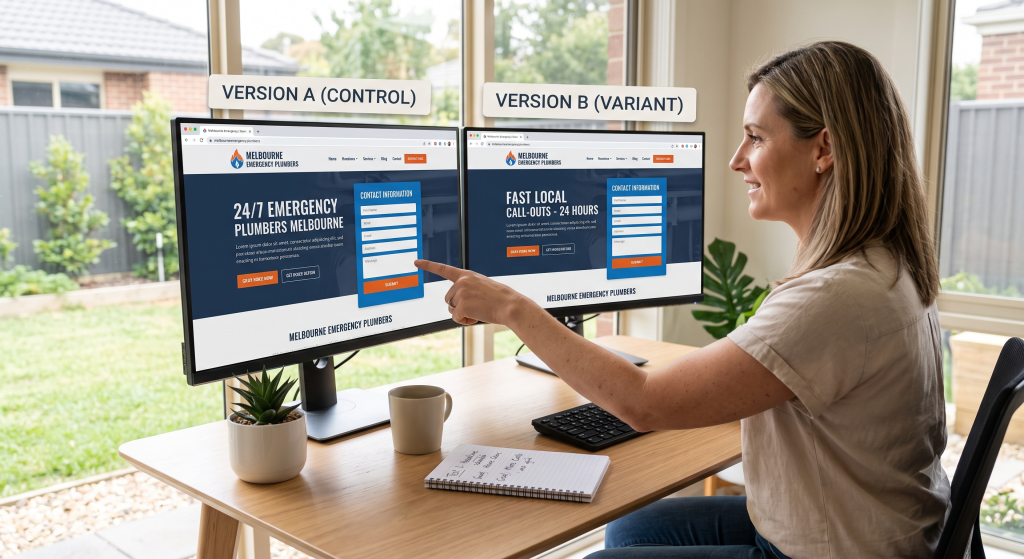
A/B testing means creating two versions of the same thing and splitting your audience between them, so you can compare real results instead of guessing which one works better.
It takes the debate out of a decision. Instead of two people in the business disagreeing about which headline “sounds better,” the actual audience decides.
Say you’re running a Google Ads campaign for a plumbing business. You might show half your audience a headline that says “Fast, Reliable Plumbers. Book Online” and show the other half “24/7 Emergency Plumbing. Call Now”.
Whichever headline gets more clicks or bookings tells you something real about what your customers respond to.
You’ll also hear this called split testing, it’s the same method, just a different name, and the two terms are used interchangeably.
How Does A/B Testing Work?

Running an A/B testing requires a structured approach. If you change too many things at once, you will never truly know why one version outperformed the other. Every A/B test, no matter how simple or advanced, follows the same three-step process underneath.
Setting Up the Test
Every test starts with your current setup, which is known as the “control” or Version A. Next, you create a copy of that asset and make a single, intentional change to create Version B, which is your “variant”.
The golden rule here is to only change one element at a time, such as a headline, a button colour, or an image. If you change the headline and the background colour at the same time, you will not know which change caused the shift in customer behaviour.
Splitting the Audience
Once your two versions are ready, your testing system will randomly divide your incoming audience into two equal groups. One group is shown Version A, and the other group is simultaneously shown Version B.
It is crucial that both versions run at the exact same time rather than one week after another. This simultaneous testing prevents outside factors, like a sudden spell of hot weather or a public holiday, from skewing your results.
Reading the Results
After your test has collected enough data, you compare the performance metrics to declare a winner. However, you cannot just stop the test the moment one version takes a slight lead after a day or two.
Instead, you need to wait until the data reaches what marketers call “statistical significance.” This is just a fancy way of saying you are 95% confident the result was driven by the changes you made, rather than pure coincidence or random luck.
What Can You Actually A/B Test? (Based on Channels)
You can test almost any digital asset that your customers interact with, provided you have a clear goal in mind. For most service-based and local Australian businesses, focusing on a few high-impact areas will deliver the best returns.
Let’s look at the three most common places where small businesses successfully run these comparisons.
Google Ads
Headlines, descriptions, and calls-to-action are the easiest places to start with Google Ads campaigns, and Google Ads has ad variant testing built in, so there’s no extra software required to get going.
A better-performing ad variant can also lift your Quality Score over time, which tends to bring your cost per click down as a bonus.
Website Pages
Once a user clicks on your ad, your website needs to convince them to take action, whether that means picking up the phone or filling out a contact form.
Small changes to your landing page design can lead to massive shifts in your overall conversion rates.
What to test on your website:
- Headlines: Test a benefit-driven headline against a straightforward service description.
- Call-to-Action Buttons: Compare “Get a Free Quote” against “Book an Inspection”.
- Contact Forms: Test a short form with only three fields against a longer form that asks for more detailed project information.
- Hero Images: Swap out a generic stock photo for a real photograph of your local team out in the field.
Emails & Social Posts
If you regularly send out email newsletters or run paid social media promotions, these channels are perfect testing grounds.
You can test two completely different subject lines on a small segment of your email database to see which one gets opened more. Whichever subject line wins can then be automatically sent to the remaining portion of your email list.
The exact same scientific principles apply to messaging hooks. For instance, a case study revealed that A/B testing two simple text variations for a mobile notification resulted in a massive 100% lift in customer open rates just by cutting out corporate jargon.
Why Should a Small Business Bother With A/B Testing?
The main reason to care about testing comes down to maximising your return on investment. Instead of spending more money to buy more website traffic, testing helps you get more value out of the visitors you already have
When you remove the guesswork from your marketing decisions, you stop wasting money on creative ideas that do not actually appeal to your target market.
Business owners who commit to a structured testing process routinely see faster, more predictable revenue growth than those who rely purely on gut instinct.
In fact, using split testing to optimise web pages and marketing assets is explicitly recommended in the Australian Government’s digital performance guide as a core strategy for growing an online presence.
Best of all, this strategy is highly accessible for smaller companies with modest budgets. You do not need millions of visitors to make meaningful improvements to your website forms or local ad campaigns.
So, A/B testing isn’t just for large companies with dedicated CRO teams. A single, well-chosen test on your busiest landing page or your best-performing ad can move the needle for a business with modest traffic.
A tradie testing two versions of a quote-request form, for instance, doesn’t need thousands of visitors to learn that the shorter form gets more submissions. Starting small beats not starting at all.
If managing these technical details feels overwhelming while you are busy running your daily business operations, we can handle the heavy lifting for you. Osten Power’s team specializes in setting up clear, reliable experiments that turn passive traffic into paying clients.
How Long Should You Run a Test?
A good rule of thumb for small businesses is to run your test for at least one full business cycle, which typically means two to four weeks.
This timeframe ensures that you capture all standard weekly variations in user behaviour, as weekend browsing habits often differ wildly from weekday patterns.
If your website naturally receives lower volumes of traffic, you will simply need to leave your tests running a bit longer to collect a reliable sample size. Patience is far more valuable than speed when it comes to gathering clean data.
Most importantly, you must ensure that you are accurately tracking your conversions before you start a test. If your conversion tracking is broken, you won’t be able to tell which version actually generated more sales or phone calls.
Common A/B Testing Mistakes to Avoid

While the concept of split testing is simple, it is incredibly easy to make mistakes that invalidate your hard work.
Avoiding these three common pitfalls will keep your data clean and ensure your marketing decisions are based on solid facts.
Testing Too Many Things at Once
The most frequent mistake beginners make is changing a headline, an image, and a button color all at the exact same time on Version B. When you bundle changes together, you completely ruin the clarity of your experiment.
If your leads suddenly double, you will have no way of knowing whether the new headline worked or if the button color made the difference. Keep your tests isolated to one single change at a time.
Stopping the Test Too Early
It is incredibly tempting to peek at your results after 48 hours and declare a winner because Version B looks like it is miles ahead. However, early data is often highly volatile and can easily reverse once a larger number of visitors browse your site.
Stepping in too early usually leads to choosing a losing variation in the long run. Let the test run its full course until your software confirms the results are mathematically reliable.
Ignoring Mobile vs Desktop Behaviour
A layout or headline that works brilliantly on a large desktop monitor might look completely broken on a small smartphone screen. If you only look at your combined overall results, you might completely miss the fact that your new variant is failing on mobile devices.
Always take the time to review your test data broken down by device type whenever your traffic volumes allow it. This ensures you aren’t accidentally damaging your mobile user experience.
FAQ About A/B Testing
A few questions come up consistently from business owners testing for the first time. These are some of them
Is A/B testing the same as split testing?
Yes, they are completely identical methods with different names. Both terms describe the exact process of splitting your audience to compare two distinct versions of a digital asset.
How much traffic do I need to run a valid test?
There’s no single magic number, but as a general guide, the lower your traffic, the bigger and more meaningful your test changes should be.
A low-traffic site is better off testing a completely different headline or offer than a small cosmetic tweak like button colour, which needs far more data to show a clear result.
Can I A/B test without expensive software?
Absolutely. Major platforms like Google Ads, Meta Ads, and email marketing providers like Mailchimp have highly capable testing tools built right into their systems for free.
You can easily start testing different versions of your ad copy without spending a single cent on dedicated external testing tools.
Conclusion
A/B testing is a low-risk, practical way to improve results from the traffic your business already has, with no bigger budget required. Starting with one test and one clear change beats waiting until you have a “perfect” testing setup in place.
Not sure where to start testing, or don’t have the time to run it yourself? Our Google Ads specialists can set up and manage A/B tests across your campaigns and landing pages, with no SEO secrets or guesswork, just transparent and data-backed results.
Get in touch with Ostenpowers to find out where your biggest wins are hiding.