SEO
SEO
 Web Design & Development
 Google Ads
 Social Media Ads
 App Design & Development
 Lawyer
 Tradies
 E-commerce



 July 6, 2026
Most small business owners aren’t short on marketing activity, they have done a few social posts here, an ad boost there when things go quiet, an offline activation, and many more.
What’s usually missing is a marketing strategy that ties it all together. It is a written plan covering who you’re trying to reach, what you’re offering them, and how you’ll reach them.
In this guide we will discuss all about what that marketing strategy is, why it matters for an Australian small business, the mistakes worth avoiding, and a simple process you can follow to build your first.
What Is a Marketing Strategy, Really?
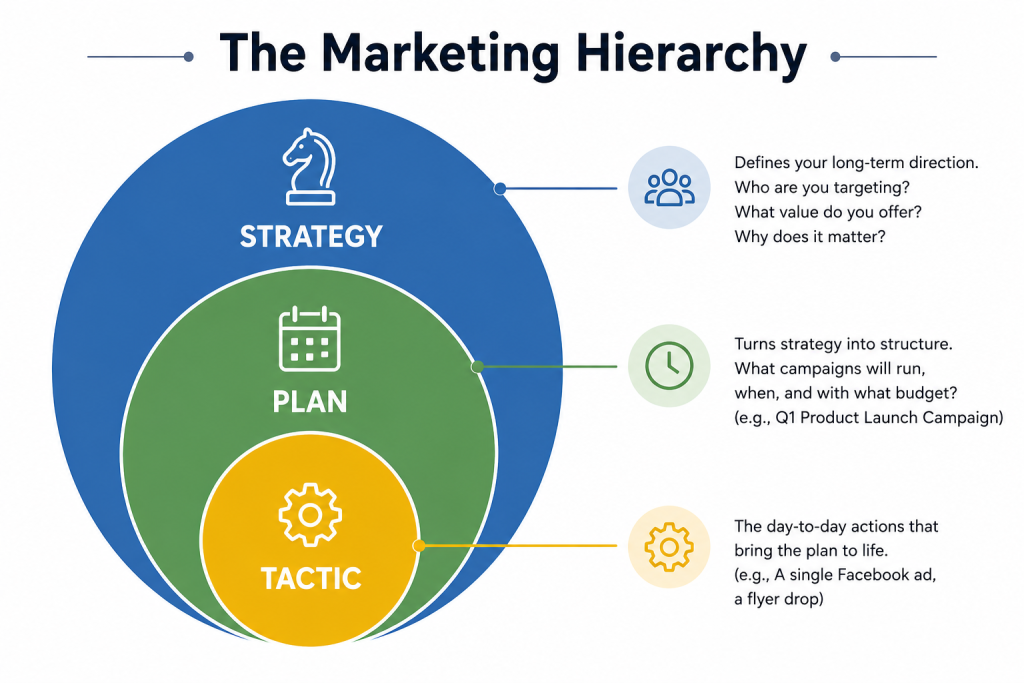
A marketing strategy is a documented plan that answers three questions: who you’re trying to reach, what you’re offering them, and how you’ll reach them. It’s the thinking that decides which tactics are worth doing in the first place.
It helps to separate three terms that often get used interchangeably. Your strategy is the overall direction (the who, what, and why). Your marketing plan breaks that direction into specific campaigns and timelines.
Your tactics are the individual actions that execute the plan, like one Facebook ad or one flyer drop letterbox-dropped around the local area.
You’ll often see this direction shaped using a framework like the marketing mix, or 4Ps (product, price, place, promotion). It’s worth knowing the term exists, but you don’t need to master it to get a working strategy down on paper.
Here’s what that looks like in practice:
A café owner whose goal is “get more visible” is really just describing a feeling, not a strategy.
Let’s compare with this situation:
A café owner whose goal is 15 extra breakfast orders a week from nearby office workers, reached mainly through local search and word of mouth, has something they can actually plan around and check progress against.
Can you spot the difference?
Why Bother When You’re Already Flat Out Running the Business?
Without a documented strategy, marketing spend tends to follow whatever feels urgent that week rather than what your audience actually responds to. We can’t call it strategy, because it is a purely reactive approach that rarely compounds into anything.
The Australian market makes this worse than it might first appear. There are 2.73 million actively trading businesses in Australia, and annual business churn runs above 30%, a genuinely crowded, fast-moving field to stand out in without a plan.
Your audience is online too, which cuts both ways. Australia has 97.1% internet penetration and roughly 78% of the population actively using social media. So, the reach is there, but so is every other business competing for the same attention. A strategy is what stops your marketing budget getting lost in that noise.
None of this requires a marketing team or a big retainer. Most Australian small businesses run their marketing part-time, squeezed in around actually delivering the work. Which is exactly why a written strategy matters more.
With a clear plan, every hour or dollar you do have goes toward something you’ve already decided is worth doing, instead of being decided fresh each time under pressure.
The Building Blocks of a Solid Marketing Strategy
Every workable strategy comes down to the same five decisions, regardless of the size of the business or the budget behind it.
Get these right and the rest (which channels, what content, and how much to spend) becomes a lot easier to figure out.
Start With a Goal You Can Actually Measure
Pick one or two business outcomes to focus on: more leads, more bookings, more repeat customers. Then turn that into a SMART goal with a number and a timeframe attached, something like “20 quote requests a month by Q3,” not “get more enquiries.”
Vague goals are the most common trap here. “Get more visible” or “build our brand” sound reasonable, but there’s no way to check later whether you’ve actually achieved them, so they don’t belong in a strategy.
Know Exactly Who You’re Talking To
Build a simple picture of your ideal customer, centred on the problem that makes them go looking for a business like yours, a specific customer demographic is better than a generic profile.
Lets say, a tradie searching “emergency plumber near me” at 11pm is a much more useful mental picture than “homeowners aged 30–55.”
It also pays to note where they actually look when researching a purchase: search engines, social feeds, word of mouth, or local directories. That detail feeds directly into the channel decision later on, so it’s worth writing down rather than guessing at.
Check What the Competition Is Actually Doing
Look closely at two or three direct competitors. Focus on what they offer, how they price it, and where they’re advertising. You don’t need a formal audit, just a look at what’s working for them and what’s clearly missing.
That gap is where the opportunity sits. If every competitor is talking price and none of them mention turnaround time or local service, that’s a gap your business can credibly own instead. Even a quick scroll through their website and social pages is usually enough to spot the pattern.
Choose the Channels That Match Your Goal and Budget
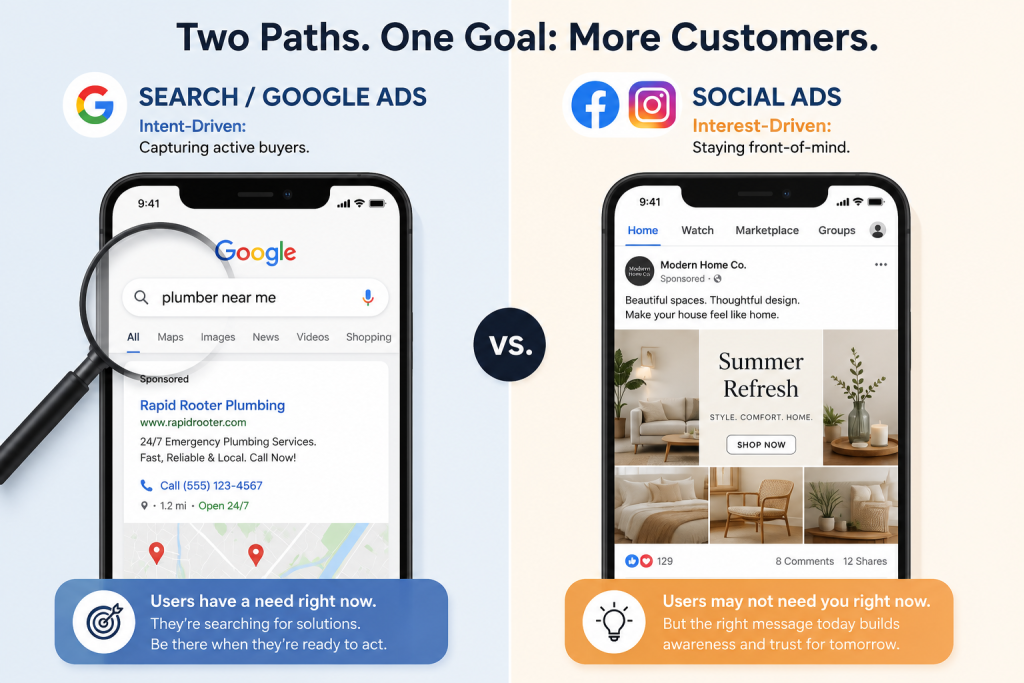
This is where the goal and audience you’ve already defined turn into an actual channel decision. SEO is the long-term, compounding option. Although it takes longer to build momentum, the visibility keeps working for you without ongoing spend per click.
It sits under the broader umbrella of search engine marketing (SEM), which also covers paid search as the other half of showing up when people are actively searching.
If you need leads faster than organic search can deliver, Google Ads puts you in front of people actively searching for what you offer, with spend that starts working from day one rather than building over months.
Social media ads, by contrast, are better suited to brand-building and reaching people before they’re actively searching at all. It is useful for staying front-of-mind with your audience between purchases.
It’s also worth a quick mention of how AI Overviews and AI-powered search results are changing the visibility picture in Australia.
Search results increasingly summarise answers directly on the results page, which makes it more important than ever that your strategy actively plans for how your business gets found, rather than assuming a listing will show up on its own.
If you’re weighing up search spend against social spend specifically, this comparison of Google Ads vs Facebook Ads is worth a read before you commit budget either way. The main thing to hold onto: most small businesses don’t need every channel running at once, just the two or three that actually match the goal you set earlier.
Set a Budget and Decide How You’ll Know It’s Working
Set a budget you can sustain for at least three to six months, not a one-off splurge you can’t repeat. Most channels, especially SEO, need consistent spend over time to show results, so a budget that dries up after one month rarely gets a fair test.
On measurement, keep it simple at the strategy stage: track leads or sales against the goal you set at the start. If you want to go deeper on working out real return on that spend, that’s covered in more detail elsewhere. For now, the strategy just needs a basic way to tell if it’s working.
As a rough guide, it’s better to commit a smaller, sustainable amount every month than to spend it all in one burst and go quiet for the rest of the quarter. Channels like SEO in particular reward consistency far more than they reward a single large push.
Common Mistakes Australian Small Businesses Make
Relying on a Single Channel
Putting all your budget and attention into one channel leaves the whole strategy exposed if that channel underperforms or gets more expensive.
Copying a Competitor’s Approach
What works for a competitor with a different budget, audience, or head start won’t necessarily work for you. Use their approach as information, not as a template to copy outright.
Treating the Strategy as a One-Off Document
A strategy written once and never revisited goes stale fast, especially as goals, budgets, or the competitive landscape shift. Revisiting it regularly is what keeps it useful.
Applying Generic Overseas Advice As-Is
A lot of marketing guidance online is written with US pricing, search behaviour, and buying patterns in mind. Applying it directly to an Australian small business without adjusting for local conditions tends to under-deliver.
A Simple 5-Step Process to Build Your First Strategy
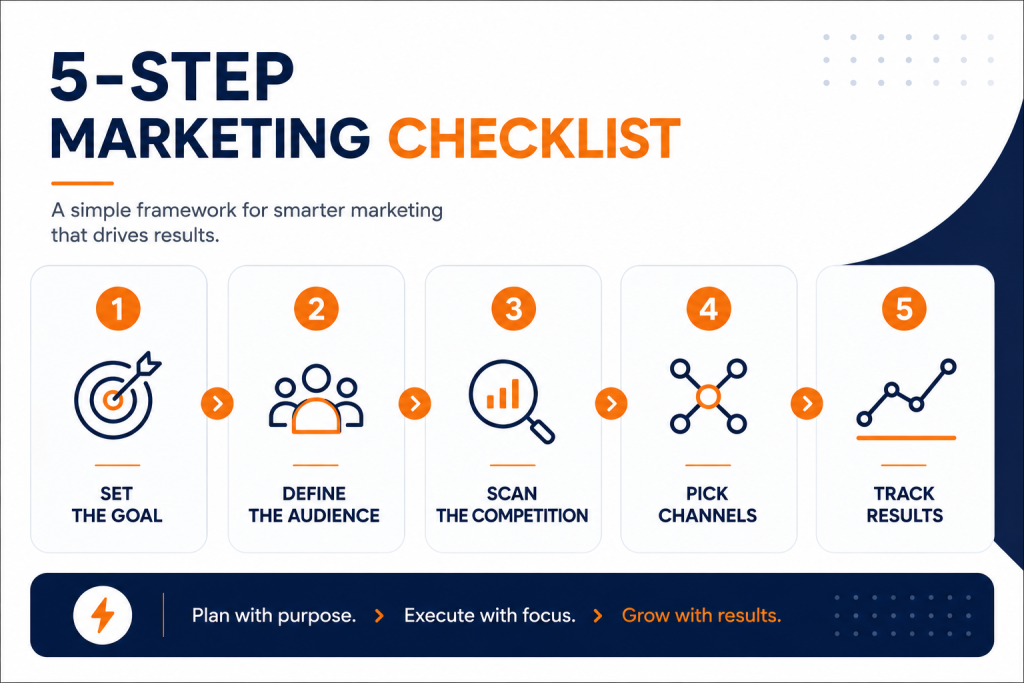
Pulling the building blocks above into a short checklist, building your first strategy comes down to five steps:
- Set the goal. It can be one or two measurable outcomes with a number and timeframe.
- Define the audience. Pay attention to the problem that sends them looking for a business like yours.
- Scan the competition. Two or three competitors, and the gap they’re leaving open.
- Pick two or three channels. Choose the ones that actually match the goal and budget.
- Set a simple way to track results. Leads or sales measured against the goal.
FAQ About Marketing Strategy
A few questions that come up often once business owners start putting a strategy together.
What’s the difference between a marketing strategy and a marketing plan?
Your strategy is the overall direction. Who you’re targeting, what you’re offering, and why. Your marketing plan is the specific set of campaigns and actions you’ll run to execute that direction.
How often should I update my marketing strategy?
Review it quarterly at minimum, and sooner if a goal, budget, or the competitive landscape changes significantly. A strategy that hasn’t been looked at in a year is usually out of date.
What’s the best marketing strategy for a small business with a tight budget?
Pick one channel that matches where your audience already is, and commit to it consistently, rather than spreading a small budget thin across several channels at once. Consistency on one channel almost always beats a scattered approach across many.
Conclusion
A marketing strategy doesn’t need to be a 40-page document sitting in a drawer. It just needs to be a clear, written answer to who you’re reaching, what you’re offering them, and how. Once you’ve got that down, the natural next step is putting it into action
Get in touch with Ostenpowers for a free consultation on turning your strategy into a working SEO, Google Ads, or social media plan.