SEO
SEO
 Web Design & Development
 Google Ads
 Social Media Ads
 App Design & Development
 Lawyer
 Tradies
 E-commerce



 July 7, 2026
The majority of small businesses in Australia don’t have a website: 59% to be exact. That leaves only 41% with a dedicated home base online, while the rest rely entirely on social pages, word of mouth, or no digital presence at all.
Having a website is only step one in marketing. Website marketing is the practice of using your site, plus the channels that drive people to it, to actually generate traffic, leads, and sales.
This guide will give you a prioritised framework for doing that. More than just a list of tactics to try all at once, it covers what the term actually means, the core channels involved, how to sequence them on a limited budget, and the mistakes worth avoiding along the way.
What Does “Website Marketing” Actually Mean?
It’s easy to assume a website markets itself once it’s live. In reality, the site and the activity that sends people to it are two separate jobs, and both need attention before either one pays off.
Building a Website vs. Marketing It
A website nobody visits doesn’t generate business, no matter how well it’s designed. Plenty of Australian SMEs invest in the build: a professional look, clear service pages, maybe an online store, and then assume traffic will follow on its own. It rarely does.
If your site isn’t converting the visitors it does get, that’s worth fixing before you spend a cent sending it more traffic; a web design and development review is the logical first step. Marketing the website is the separate, ongoing job of actively sending the right people to it, then converting them once they land.
Think of it this way: a tradie with a beautifully built site and zero traffic is in the same position as one with no site at all. Both are invisible to the customer searching for their service. The build earns you a destination. While the marketing is what actually gets someone there.
Why This Matters More in 2026
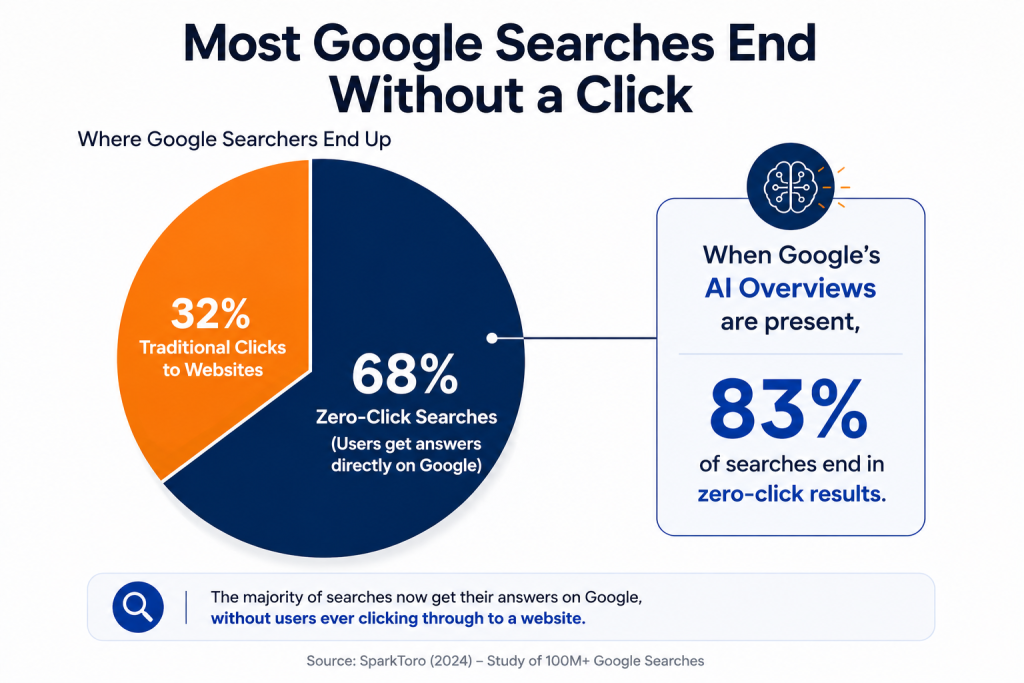
Search behaviour has shifted. According to SparkToro and Similarweb data, a staggering 68% of Google searches now end without a single click to an external website.
When an AI Overview appears on the results page, that zero-click rate climbs to a massive 83%. Ranking well is no longer enough on its own. Increasingly, visibility also means being the source AI tools summarize rather than just holding the #1 spot.
That raises the stakes for pairing a genuinely useful, discoverable website with channels that actively bring in traffic, rather than waiting for people to stumble across it.
The Core Channels of Website Marketing
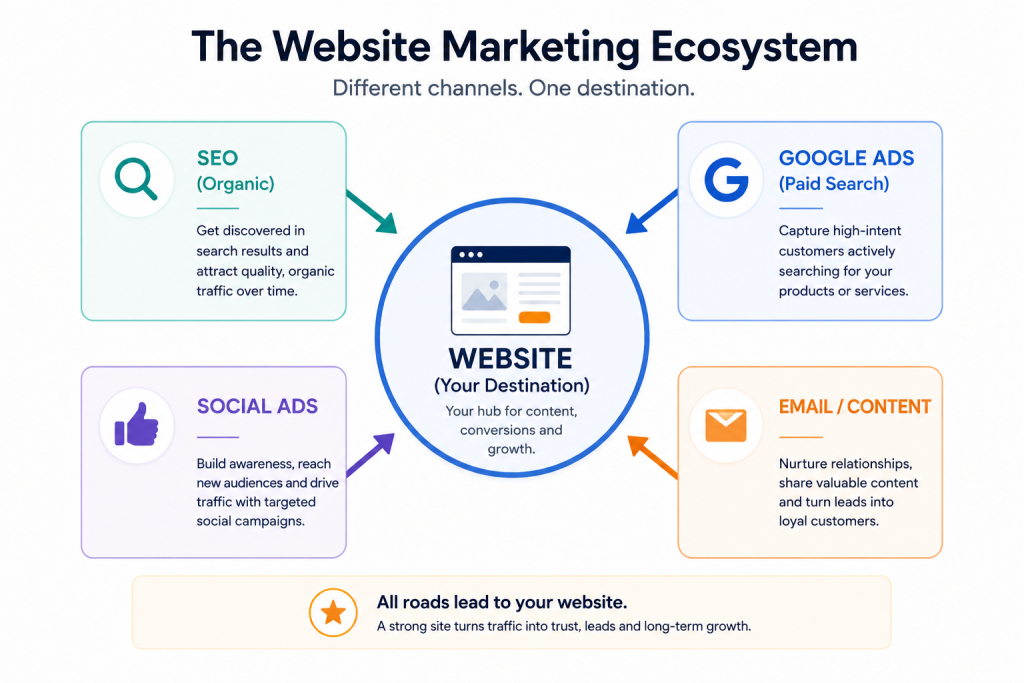
Most website marketing activity falls into four groups: organic search, paid search, social media, and content and email. Here’s what each one actually does for your site.
SEO: Getting Found in Organic Search
SEO builds traffic that keeps showing up without ongoing spend per click, but it takes months to gain real momentum. Getting the fundamentals (site structure, page speed, local signals) right is the foundation everything else in this section builds on; that’s what SEO services are for.
On budget: recent Australian pricing data puts small business SEO at roughly $1,200 to $2,500 a month for a genuine, ongoing campaign. Below that, you’re typically only getting basic on-page fixes rather than the content and local optimisation that drives results.
If you think effort is what matters most, we have to disappoint you because the real trade-off is time. Most Australian businesses start seeing early movement in rankings and enquiries within three to four months, with the meaningful gains showing up closer to six to nine months of consistent work.
That timeline is exactly why SEO pairs so well with a faster channel while it builds in the background.
Paid Search: Google Ads & SEM
Paid search puts your site in front of people the moment they’re searching for what you offer, which makes it useful for new businesses with no organic history yet, or for seasonal promotions that can’t wait months to build momentum.
It sits within the broader discipline of search engine marketing (SEM), which covers both paid and organic search together.
Google Ads is the main way Australian SMEs run paid search, and it’s best thought of as a complement to SEO rather than a replacement for it. One gets you visible today, the other keeps you visible for free once it’s built.
The clearest sign paid search is right for you: a genuine “we can start next week” need for leads, or a promotion with a hard deadline. Spend flexes with budget too, which makes it easier to test a channel without committing to a long runway the way SEO requires.
Social Media Marketing & Ads
Organic social builds trust and community over time, paid social media ads buy reach and precise targeting when you need it faster.
Both feed back into your website in several ways. It can be driving traffic to specific pages, promoting blog posts or service pages, building brand awareness before someone’s actively searching, supporting retargeting campaigns, and/or distributing the content your site already has.
That’s a meaningful audience to build on: according to DataReportal’s Digital 2026 Australia report, roughly 78% of the population is active on social media, and the large majority access it on mobile.
Content & Email Marketing
Blog posts and guides keep the site fresh, support your SEO effort, and answer the questions buyers are actually typing into Google before they’re ready to enquire.
Email does the follow-up work by bringing visitors who weren’t ready to buy on their first visit back to the site when the timing’s right. Neither needs to be complicated to be worth doing consistently.
How to Prioritise Website Marketing on a Small Budget
Now let’s try to answer this question: With limited time and money, which of the channels above should actually come first?
The answer depends less on what’s trendy and more on how quickly you need results. Let’s break it down.
Quick Wins vs. Long-Term Investments
Paid search and paid social are quick wins, visibility starts almost immediately, but it stops the moment the spending stops.
On the other hand, SEO and content are long-term investments, slower to build, but they keep working long after the initial effort goes in. The most resilient approach for an Australian SME usually combines one of each, rather than betting everything on a single channel.
Neither approach is inherently better because they solve different problems. A business that needs its calendar filled this month has a different, entirely valid need than one planning twelve months ahead, and the right channel mix follows from that difference rather than from whichever tactic sounds most impressive.
A Simple Way to Choose Your First Channel
If you need leads now, start with paid search or paid social. They’re the fastest route to a visible result.
If you’re playing the long game and can commit to consistent spend for six months or more, start with SEO and content instead.
And if your website isn’t converting the traffic it already gets, fix the website first before paying to send it more visitors. Audit everything including the content, the UI/UX, even the web design and development.
Common Website Marketing Mistakes Australian Businesses Make
A few patterns show up again and again in Australian SME marketing, and each one is avoidable once you know to look for it.
Sending Paid Traffic to a Slow or Confusing Website
Running ads to a site that’s slow to load or unclear about what to do next wastes ad spend on a leaky funnel.
The click was paid for, but the visitor leaves before converting. It’s worth testing your own site on a mobile connection before switching any campaign on, since that’s how most of your traffic will actually arrive.
Spreading a Small Budget Across Too Many Channels
Trying to run SEO, Google Ads, and social ads all at once on a modest budget usually means none of them get enough spend or attention to actually work. A small budget split three ways rarely outperforms the same budget committed fully to one or two channels.
Ignoring Google Business Profile and Local Search Signals
Australian search behaviour leans heavily local, and a neglected or incomplete Google Business Profile means missing out on exactly the searches most likely to convert: the “near me” and local-intent queries that sit closest to a purchase decision.
Treating SEO and Paid Ads as Separate Efforts
The two work best as one connected system. The keywords your ads convert on are often a strong signal for what your SEO content should target next, and vice versa. Businesses that run them in silos usually end up duplicating effort instead of compounding it.
FAQ About Website Marketing
A few questions that come up often once business owners start looking into this properly.
Is website marketing the same as digital marketing?
Website marketing is a subset of digital marketing focused specifically on the site as the destination. Digital marketing is the broader umbrella covering every channel and goal a business has online, whether or not it points back to a website.
How much should an Australian small business budget for website marketing?
Spend depends on the channel and the goal. The roughly $1,200–$2,500 a month range for SEO is a useful reference point, and paid channels like Google Ads and social ads can flex up or down with budget in a way SEO generally can’t.
How long does it take to see results?
Paid channels can drive traffic within days of launching. SEO and content typically take a few months to build real momentum, which is exactly why combining both smooths out the wait.
Paid search covers the gap while SEO builds underneath it, so you’re not left with no visibility while the longer-term channel gets going.
Conclusion
Website marketing is a connected system of website, traffic channels, and conversion all working together. The strategy that you need is to skip any one piece and the others struggle to deliver.
The right starting point depends on your budget and timeline, not on chasing every channel at once.
If you are still not sure which channel deserves your budget first, Ostenpowers can review your website and recommend a marketing mix that fits your goals, whether that’s SEO, Google Ads, social media ads, or a website rebuild.